

Facilities managers are increasingly becoming employee experience (EX) designers and are now borrowing skillsets and methodologies from user experience specialists. That’s according to a new study from Smartway2, a unique cloud-based software solution that enables businesses to help their people, places and technology work better together.
“HR and facilities managers are stepping up to create a more engaging employee experience by adapting processes and tools originally devised by user experience designers to optimise the customer journey,” said Smartway2’s CEO John T. Anderson.
Smartway2 found that the growing emphasis on employee experience is a result of more companies recognising that giving employees a better workplace experience helps them attract and retain the best talent—and can therefore be a source of competitive advantage.
This advantage was highlighted by Jacob Morgan in his book The Employee Experience Advantage. Morgan analysed over 250 diverse organisations and discovered that companies that invest in employee experience are four times more profitable than those that don’t.
When it comes to designing the workplace of the future, HR and facilities managers are learning from the experience of UX design, marketing and customer service, says the Smartway2 report. These external-facing business areas have invested heavily in understanding how to deliver engaging journeys—and pull people through funnel stages—by creating a compelling experience.
Smartway2 cites Apple’s new $5 billion Apple Park as an example of how forward-looking organisations are increasingly investing in their employer brand as well as their consumer-facing brand. Apple’s new flagship offices provide an exceptional experience for employees and visitors, as well as making a statement about the company’s vision and values.
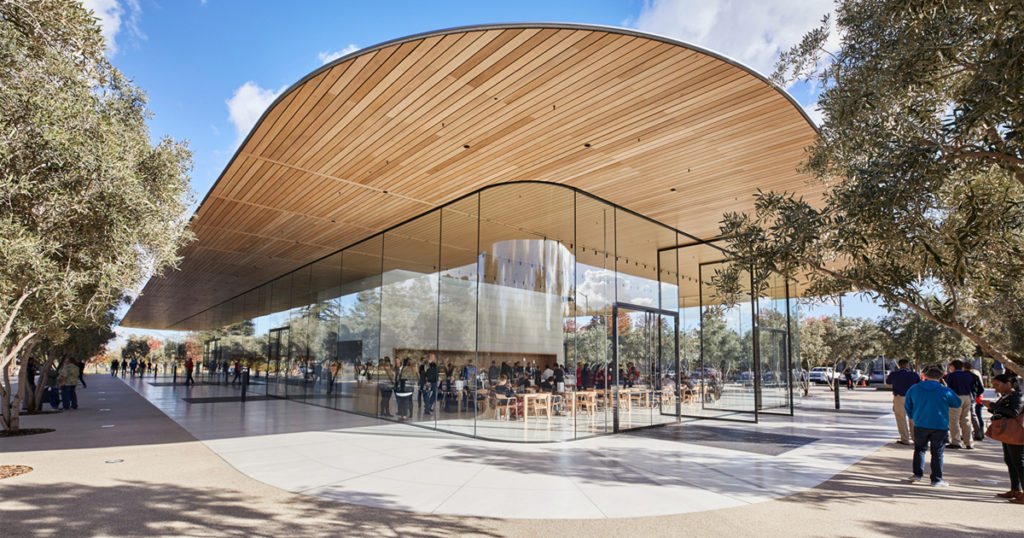
The Apple Park site (pictured above) runs entirely on renewable energy generated by solar panels and an ‘on-site low carbon central plant’. Most employees will sit around large 18-foot round tables in open plan areas to improve collaboration. The beautifully landscaped campus boasts 7,000 trees, a 100,000 square foot fitness centre, 300,000 square foot R&D facilities, two miles of walking and running paths, an orchard, a meadow, a pond and 1,000 bikes.
Experience designers typically begin by researching their users to understand who they are, what matters to them and how to deliver what they need. They use these insights to identify personas and explore day-to-day scenarios that people may find themselves in.
The next step is to create an information architecture to make it easy for users to navigate to the right place and achieve their goals. Finally, they sketch and prototype a solution before trying it out on users to test what happens in the real world. This agile ‘test and learn’ approach is a fundamental aspect of experience design.
“Facilities managers need to identify and optimise every single employee touchpoint, both online and offline, to create an engaging, energising experience that will help an organisation to attract, keep and grow talent.,” said Smartway2’s Anderson.
He added: “That’s why Facilities and HR need to focus on up-skilling in order to adapt to a fast-changing environment and provide the experience that 21st century workers expect. Facilities experts who are armed with design thinking skills are likely to thrive.”
# # # #


 Workplace journal
Leave a comment