

Workplace wellbeing has never been more crucial, and organizations are finally recognizing that a happy, healthy workforce leads to better productivity, engagement, and long-term success.
As work environments continue to evolve, prioritizing employees’ mental and physical health is no longer just an ethical responsibility; it is a business necessity.
Focusing on workplace wellbeing can lead to reduced burnout, improved job satisfaction, and stronger collaboration among teams. And companies that invest in employee wellness programs, flexible work arrangements, and supportive leadership often see lower turnover rates and higher performance.
So what is workplace wellbeing?
According to job posting website Indeed, workplace wellbeing is defined as “how someone feels about their job or the safety of their work environment”. It found that multiple factors come together to influence workplace wellbeing — including work environment, physical health, mental health, emotional health, compensation, sense of purpose, and trust in leadership.
Significantly, a study of 46,000 employees suggested that individual mental health interventions are not enough to improve wellbeing. Organization-wide interventions are needed
Here are five key steps organizations can take to boost workplace wellbeing.
1. Maintain a culture of psychological safety.
Psychological safety is at the heart of improving workplace wellbeing. It is described as “feeling able to show and employ one’s self without fear of negative consequences of self-image, status, or career.” In a workplace context, that means believing you won’t face negative consequences if you ask for help, admit you’ve made a mistake, or dare to challenge the norm.
The more psychological safety an individual feels, the better their state of emotional wellbeing. A 2022 study of accountant employees found that psychological safety positively impacted both intrinsic and extrinsic motivation and wellbeing.
Workplaces without psychological safety are also workplaces where progress is stifled.
Psychological safety starts with, and is modelled by, an organization’s leadership team. It begins with a mindset that employees are just as important as getting results — which is not a given at every organization.
A culture of psychological safety is also a culture of accountability, trust and transparency, Three steps recommended by Harvard Business Review are: letting go of perfection, advocating for diversity, and communicating with consideration, vulnerability and empathy.
2. Give employees autonomy to decide how and where to work.
It is generally recognised that successful relationships are built and maintained on trust. But that is not always true when it comes to relationships between workplace leaders and employees. And the overall state of wellbeing is suffering as a result.
Hybrid work has exacerbated the consequences of this lack of trust and autonomy. It all stems from a misplaced fear of unproductivity. A study by Slack revealed that a quarter of employees do not feel trusted at work. This is probably because 70% of leaders reported measuring productivity based on visible activity only. In response, 32% of employees reported doing busy work just for the sake of it.
Almost half of employees link excessive monitoring to increased anxiety. And a similar number of Gen Z and millennial employees surveyed by Deloitte report that a lack of control over how and where they do their work contributes to anxiety and stress.
Feeling like you are not trusted doesn’t just increase anxiety. It also causes people to spend more time on unfulfilling work. A sense of purpose and mastery can’t exist in this strange new dynamic. It is making the world of work much more stressful for employees and also for managers who can’t achieve their objectives when no one is doing any real work.
The case for giving individuals and teams autonomy to decide how and where to get their best work done is a strong one — despite all the ‘full-time in office’ mandates seen in news headlines.
Architecture firm Gensler found that employees in innovative companies spend 36% of their time working in places that are neither the office nor home, compared to just 20% at the least innovative companies. For employees at innovative organizations, almost 75% of their meetings are hybrid meetings versus just over half at the least innovative businesses.
Research already shows how hybrid work can boost wellbeing, with 66% of 2000 employees surveyed by IWG reporting better mental wellbeing. Without all those hours spent sitting in traffic, or on public transport, employees also claimed they had gained an extra 71 hours of sleep per year.
Organizations can boost autonomy by rejecting hard-line RTO mandates or backtracking if they have already gone there. Instead, they can give managers the autonomy to decide on team-level agreements or provide attendance guidelines if they would really like people to come in for a minimum number of days.
3. Invest in office amenities people actually want and use.
Workplace leaders looking at novel office amenities, such as ping pong tables, as a way to get more people into the office are missing the point entirely. Gimmicky amenities might attract some curious visitors initially but then lose their appeal after everyone finds they don’t make anyone feel, or work, any better.
Amenities should provide two things:
- Novel experiences. These improve neuroplasticity (the brain’s ability to rewire itself) and can even help people break out of cycles of negative thinking and rumination. So, as long as it is not a gimmicky one-time thing, amenities like fitness classes or after-work socials can boost wellbeing. They can even help employees find new ways to tackle that blocker they can’t seem to move past.
- Mental and emotional regulation. Every job has its stressful moments. Most of these should be ‘positive’ stressors that drive employees to challenge themselves and work more efficiently. But there are bound to be moments that have people feeling just a little more snappy than usual. Amenities like meditation rooms, nap pods and green spaces give people a place to process and relax — instead of brushing stress or negative feelings under the rug, only to have them re-emerge later as a mental or physical health issue.
Here are some ideas for workplace amenities that boost wellbeing, and the science behind them:
Green spaces: A 2015 study found that employees in environments with biophilic design were 6% more productive, 15% more creative, and 15% more satisfied with their work. What counts as a green space? Think nice views of nature, natural lighting, and lots of real plants.
Fitness facilities (on-site, subsidized, or both): Regular exercise boosts resilience to acute stress, so providing easier access to exercise is an amenity that enhances wellbeing. But there has to be something for everyone. Some people let the stress drift away in a Hatha yoga class, while others blast it away doing pullups.
Meditation rooms: Quiet rooms where people can sit in silence — whether they are actively meditating or just zoning out — have been proven to reduce stress and burnout. In a study published last year, serenity rooms were found to prevent burnout and boost wellbeing in nurses during COVID-19. Even VR relaxation sessions have been proven to effectively reduce workplace stress.
Healthy meals, snacks and drinks. Friday beers and unlimited chocolate almonds might feel nice in the moment, but do they really boost wellbeing in the long run? Employees who make mostly unhealthy food choices are 66% more likely to be less productive than their healthier eating peers. Healthy options also eliminate that decision fatigue of what to pack for lunch every day!
4. Create spaces and events that boost social connection.
Experts argue that loneliness is tied to an increased risk of Type 2 diabetes, heart disease and stroke. And while loneliness does not just happen at work, feeling more socially connected from 9 to 5 has wellbeing benefits that reach much further than the time spent behind a desk.
Unfortunately, 55% of employees report feeling lonelier since starting hybrid work, according to Gallup. Forcing people to ‘connect’ through being in the same space does more harm than good, it seems.
The right kind of social connection creates a buzz and a boost to wellbeing. While it is never going to be possible to make sure every single employee is getting that social connection boost, the most that workplace leaders can do is facilitate the perfect times and places for it to happen.
One way to do this is through events. Team days in the office, mentorship meetings, and after-work socials and classes all fall into this category. Even a remote-first company like Atlassian found that employees coming together in-person three or four times a year produced tangible wellbeing benefits. Atlassian employees reported a 96% boost in satisfaction and a 27% increase in team connection after an in-person meet up.
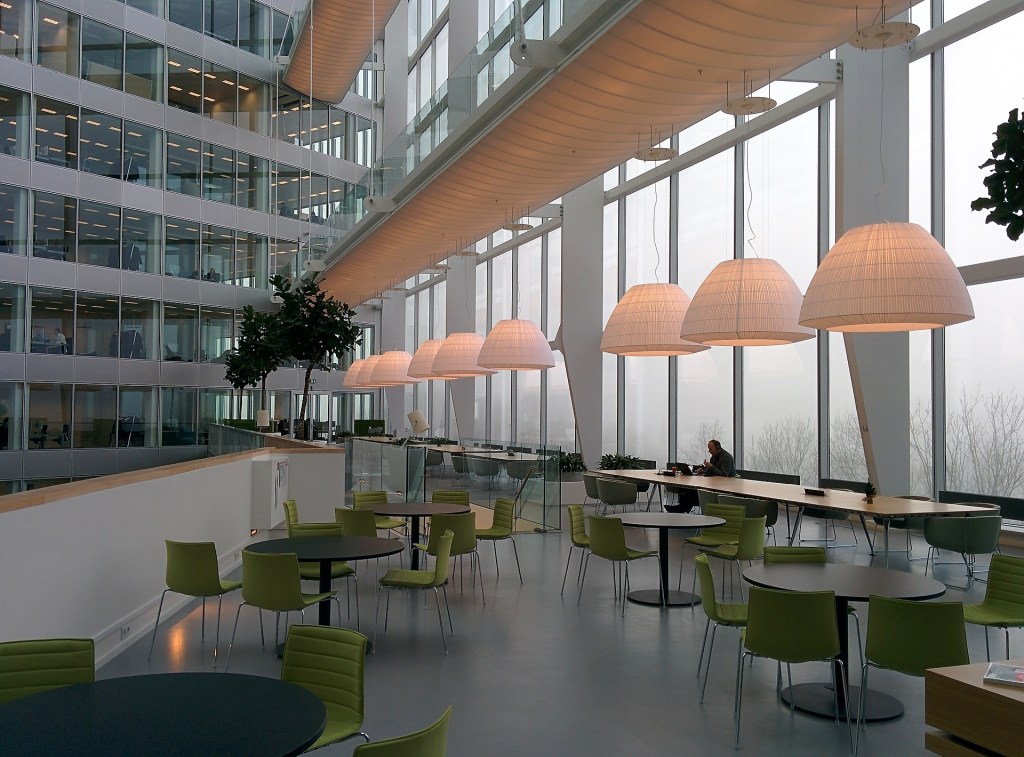
Another way to boost connection is through the design of workspaces. Modular auditorium spaces for large gatherings are becoming a key facet of workplace design these days. The same is true for informal collaboration spaces. German media company RTL’s recent office redesign features two large informal meeting spaces and even circular coffee counters throughout the building to make them more sociable.
5. Use data to put diverse spaces at the core of workplace design.
Workplace design can have a huge impact on employees’ mental and emotional health as well as their productivity.
It is also common knowledge that different people tend to have different preferences when it comes to their work environment. Despite this, only a third of workplaces have been redesigned over the past three years, according to Gensler’s 2024 Global Workplace Survey. This means employees at two thirds of workplaces are trying to shape their work habits around their work environment.
For example, a 2024 study found that employees experienced higher emotional exhaustion when working in hot desking layouts and open plan offices. Interestingly, men and women in this study reported different levels of emotional exhaustion and psychological demand in these environments.
Using accurate occupancy data will enable organizations to redesign their workplace with enough layouts and space types for everyone. Quantifying employees’ choices of work environment will help designers to create more of the right spaces — and the performance of those spaces can be tracked over time. Feedback from employee surveys and focus groups is also essential.
Another upside of measuring occupancy data is that it shows what each specific workplace requires, rather than just following what everyone else is doing.
Not having enough meeting rooms is a complaint as old as time, but Gensler’s survey shows that, globally, employees tend to spend the same amount of time working individually as they do collaboratively. Data and feedback will show workplace leaders what the split of individual-versus-collaborative work looks like at their organization (along with the categories each falls into).
Not all meetings are the same, of course. Some need a soundproof room, some need AV equipment, and some can be done from a nice comfy sofa. For example, outdoor clothing brand LL Bean’s HQ features two treehouses for relaxing and informal meetings.
Not all individual work is the same either. Some projects require total silence; some benefit from occasional interactions with colleagues; and some need to be done right next to a phone booth for that call in ten minutes.
A workplace that makes people feel good about their work, and about themselves, must be designed to accommodate all of these different working styles.

Main image by Yamu Jayanath



 Workplace journal